

Material-compatibility guide
The right sex doll lubricant is not chosen by thickness or marketing language alone. Start with the exact material, any removable insert and the maker’s instructions. This guide explains how to compare water-, silicone-, oil- and hybrid-based products without making unsafe assumptions across different TPE and silicone formulations.
Choose sex doll lubricant by compatibility, not by label
“TPE,” “silicone” and “hybrid” are broad labels. Formulations, surface finishes, pigments, painted details, seams and inserts vary. A lubricant that works with one product should not automatically be treated as safe for another. The product manual or the manufacturer’s written answer for the exact model takes priority over a general article.
Check the body and the part that will actually contact the lubricant. A silicone body may have a removable insert made from another material. A TPE body may include painted areas or electronic functions with separate restrictions. If the listing and manual disagree, pause and ask support with the exact product URL, order configuration and lubricant ingredient list.
Water-based, silicone-based, oil-based and hybrid lubricants compared
| Lubricant type | Practical advantage | Main compatibility question | Decision |
|---|---|---|---|
| Water-based | Usually easier to rinse and widely specified in doll-care instructions. | Does the exact doll or insert manual approve it, and are there additives with separate instructions? | Use the documented product; reapply if it starts to dry rather than allowing friction. |
| Silicone-based | Often marketed for longer-lasting slip. | Could it interact with a silicone surface, coating, paint or insert? | Do not use on assumption. Obtain explicit written compatibility for the exact material. |
| Oil-based | May feel persistent and resist drying. | Could oil soften, stain, swell or change TPE, silicone, paint, adhesives or finishes? | Avoid unless the maker specifically approves the product for that model and explains removal. |
| Hybrid | Combines water with another lubricant base. | What is the non-water component, and is that component approved? | Treat it according to all ingredients, not the word “hybrid.” Ask before use. |
Water-based is a useful default category, not a blank cheque. Some formulas contain fragrance, warming or cooling agents, numbing ingredients, colour, glycerin or preservatives. Those features may affect cleaning, personal comfort or a particular finish. The shortest ingredient list is not automatically the best, but a clearly labelled product with manufacturer guidance is easier to assess than an unlabelled decanted liquid.
The official RealDoll Classic care guide available in 2025 instructs owners of that specific silicone product to use water-based lubricant and avoid oil-based lubricant. That supports the general direction, but it does not prove that every lubricant is safe for every SexDollsStation model. Different makers and materials require their own confirmation.
Five checks before a new lubricant touches the doll
How much lubricant should you apply?
Use enough approved lubricant to prevent dry friction on the intended contact area. Start with a controlled amount, spread it gently and add more when needed. If the surface begins to feel dry or drag increases, pause and reapply instead of pressing harder. This is especially important around painted details, seams and narrow openings.
Do not pour liquid across the whole body. Keep lubricant away from charging ports, motors, speakers, heating connections, sensors and other electrical parts unless the manual explicitly states otherwise. For a removable insert, follow the insert’s own instructions for removal, lubrication, cleaning and drying.
Remove lubricant residue, rinse as directed and dry fully
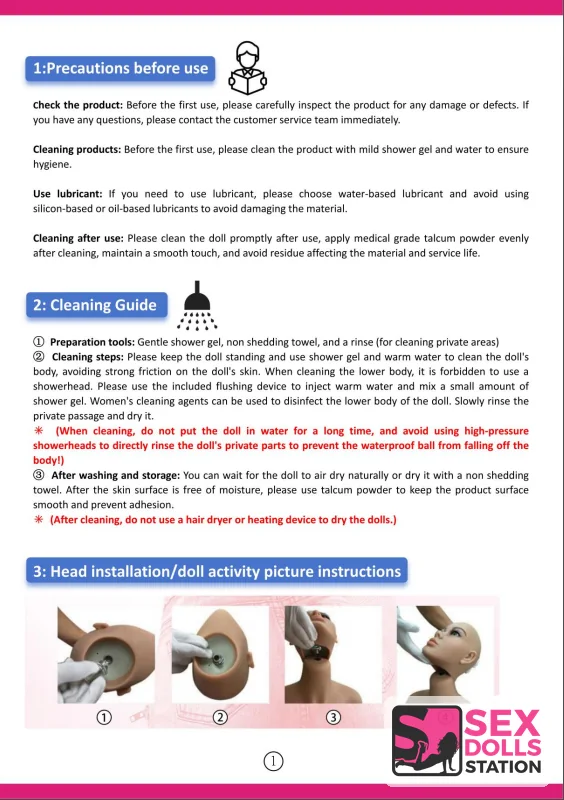
After use, follow the maker’s cleaning sequence rather than improvising with household chemicals. The SexDollsStation care guide recommends lukewarm water, a mild unscented cleaner approved for the material, soft lint-free cloths and complete drying. It also warns against automatically using alcohol, bleach, solvents, abrasive tools, direct heat or unapproved oils.
- Remove visible lubricant using the method approved for the exact surface or insert.
- Use lukewarm—not very hot—water when the instructions allow rinsing.
- Do not force water into the head, neck connector, electronics or sealed areas.
- Rinse away cleaner and lubricant residue; pay attention to folds and textured areas.
- Pat the exterior gently and let approved areas dry completely before storage.
- Inspect for tackiness, colour transfer, swelling or a changed finish.
Never store the doll while internal areas remain damp. Moisture trapped in an insert or cavity can create odour and makes later inspection harder. Use only the drying method allowed by the manufacturer; direct heat can damage surfaces and electronics.
Common lubricant mistakes that create avoidable risk
Assuming all dolls of one material are identical
Two products described as silicone may use different formulations, pigments, coatings or inserts. Compatibility belongs to the exact product system, not merely the category name.
Using more force when lubricant dries
When drag increases, stop and add approved lubricant. More force can stress a surface, seam or painted finish. Do not use a damaged area until it has been assessed.
Relying on a vague “safe for toys” claim
Look for the named material, manufacturer instructions and a complete product label. If the compatibility statement is unclear, ask before applying it to a large or visible area.
Adding fragrance, massage oil or household products
A product intended for skin, massage or cleaning is not automatically compatible with TPE, silicone, paint or adhesives. Avoid experiments that are difficult to reverse.
Cleaning the body but forgetting an insert
Removable parts need their own cleaning and drying process. Confirm which components can be rinsed and which must remain dry.
Sex doll lubricant buying checklist
- Exact doll model, body material and insert material confirmed.
- Written maker instruction available for the chosen lubricant type.
- Full ingredient label, warnings and expiry information readable.
- No unapproved oil, silicone or hybrid component.
- No numbing, heating or cooling feature unless personally suitable and approved.
- Cleaning method and required drying tools understood before use.
- Original bottle retained for traceability.
- Support contacted before use when any point remains uncertain.
Lubricant is one part of an ownership routine. Before ordering a doll, also plan for cleaning access, drying, storage and the weight you will handle repeatedly. The beginner’s guide connects those steps.
Sex doll lubricant FAQ
Is water-based lubricant safe for every sex doll?
It is commonly recommended and is usually the lowest-risk starting category, but no article can guarantee every formula on every material. Check the instructions for the exact doll or insert and the full lubricant label.
Can I use silicone lubricant on a silicone doll?
Do not assume compatibility. Silicone formulations and surface finishes vary, and the manufacturer may prohibit silicone-based products. Use it only if the maker confirms the exact lubricant and contact material in writing.
Can I use baby oil or massage oil on TPE?
Only when the manufacturer explicitly approves that exact product for the exact TPE formulation. Oil can be difficult to remove and may change some materials, pigments or finishes. The general SexDollsStation care guide does not recommend automatic use of baby oil.
Why does water-based lubricant become sticky?
Water can evaporate during use, leaving a more concentrated residue. Pause, follow the product instructions for reapplication, and clean the doll afterward using the approved method. Do not correct stickiness by adding an incompatible oil.
Should I patch-test a lubricant?
Only if the doll maker permits it. Test a tiny concealed area, follow the specified observation period and clean it as directed. A patch test cannot prove long-term compatibility, so manufacturer approval still matters.
What should I do if the surface changes?
Stop using the lubricant, keep the bottle, photograph the area under neutral light and contact the seller or maker with the model, material, product name and cleaning steps used. Do not apply solvent or repair chemicals without instructions.
Sources, review date and scope
Reviewed 2 October 2026. The compatibility process and cleaning boundaries use the current visible SexDollsStation care guide. The water-based recommendation for a named silicone product is corroborated by the official RealDoll Classic Care Guide published in a 2025 document path. That external guide applies to RealDoll’s product, not automatically to other brands or TPE formulations.
This page intentionally avoids universal compatibility, health, longevity and warranty claims. Materials, care instructions and lubricant formulas can change. Recheck the live manual and label for the exact product before each new combination.
